
For someone living with a serious diabetic foot wound, one question can become urgent: Can hyperbaric oxygen therapy (HBOT) help prevent amputation?
In certain patients, the answer may be yes.
Research has found that HBOT, when used as an adjunct to standard wound care, can improve healing and may reduce the risk of major amputation in selected patients with limb-threatening diabetic foot wounds.
However, HBOT is not a guarantee that an amputation will be avoided, and it is not a replacement for wound care, vascular evaluation, infection treatment, blood-sugar management, debridement, or other medically necessary treatments.
For patients who may qualify, the goal is straightforward: help the body heal a difficult wound before the damage progresses to the point where amputation becomes necessary.
At the CNS Brain Center in Chicago, hyperbaric oxygen therapy is provided in a medical-center setting using medical-grade hyperbaric chambers, physician oversight, and dedicated HBOT technicians and nurses.
How Can HBOT Help a Wound at Risk for Amputation?
What Does the Research Say About HBOT and Amputation?
Research on HBOT for diabetic foot wounds has produced encouraging results, although the evidence is not completely uniform.
Systematic reviews and meta-analyses have found that adjunctive HBOT may improve healing and reduce major amputation rates in selected patients with diabetic foot ulcers. However, findings across studies have not been completely consistent, and limitations in study quality and patient selection remain. For that reason, HBOT is generally considered for appropriately selected wounds rather than used routinely for every diabetic foot ulcer.
At the same time, other reviews have found less conclusive results and have emphasized limitations in the available studies.
This is why HBOT should be viewed as a selective, evidence-based adjunctive therapy, rather than a universal treatment for every diabetic foot ulcer.
The takeaway is not that HBOT can guarantee that an amputation will be avoided. But, for appropriately selected patients, HBOT may improve the odds of healing a serious wound and preserving the limb.
When Is HBOT Used for Diabetic Wounds?
Hyperbaric oxygen therapy is generally considered after appropriate standard wound care has been attempted and a wound continues to pose a significant threat.
For Medicare coverage, diabetic lower-extremity wounds must meet specific criteria. The patient must have type 1 or type 2 diabetes, the wound must be due to diabetes and classified as Wagner grade III or higher, and there must be no measurable signs of healing after at least 30 days of standard wound therapy. HBOT is covered as an adjunct to continued standard wound care, not as a replacement for it.
Standard wound care can include:
- Evaluation and treatment of circulation problems
- Blood-glucose optimization
- Debridement of damaged or dead tissue
- Appropriate wound dressings
- Off-loading pressure from the affected foot
- Treatment of infection
- Nutritional optimization
- Ongoing monitoring of wound healing
The earlier a serious wound is properly evaluated, the more opportunities the medical team may have to intervene before an amputation becomes necessary.
Not All “Hyperbaric Therapy” Is the Same
This distinction is important for patients researching HBOT.
Today, consumers may encounter soft-shell chambers, mild hyperbaric systems, wellness facilities, chiropractic offices, and medspas that advertise services using terms such as “hyperbaric therapy” or “hyperbaric oxygen therapy.”
These services can differ substantially from medical-grade HBOT in chamber design, pressure, oxygen delivery, clinical oversight, and intended use.
For someone seeking treatment for a serious medical condition, particularly a wound that may threaten a limb, the differences matter.
Patients should ask:
- Is this a medical-grade hyperbaric chamber?
- What pressure does the chamber reach?
- What concentration of oxygen will I breathe?
- Is the treatment supervised by qualified medical professionals?
- Does the facility treat recognized medical indications for HBOT?
- Is a physician involved in determining whether HBOT is appropriate?
- Are trained HBOT technicians and nurses available?
- Will the HBOT team coordinate with my other physicians and wound-care providers?
- Does the facility accept insurance for qualifying medical conditions?
The answers can help patients distinguish medical HBOT from wellness-oriented or mild hyperbaric services.
Chicago’s Only Certified Medical-Grade HBOT Center
For patients in the Chicago area, where HBOT is performed can matter just as much as the therapy itself.
The CNS Brain Center is the only certified medical-grade HBOT center in Chicago. The CNS Brain Center is a medical center, not a medspa, and its HBOT program is designed around medical treatment, physician oversight, specialized equipment, and dedicated clinical staff.
The center’s medical-grade HBOT program offers several important distinctions.
Large, See-Through Chambers
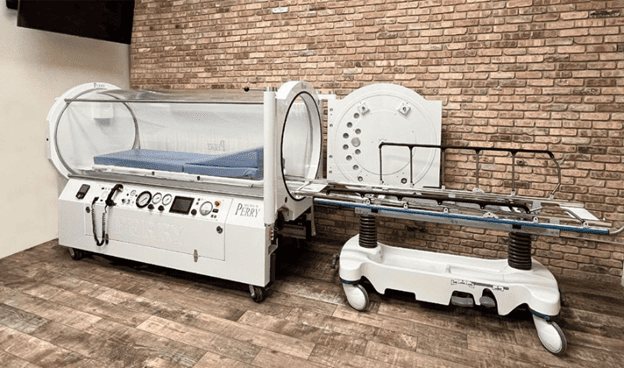
The CNS Brain Center uses Perry Baromedical SIGMA 36 hyperbaric chambers, which feature a large, clear acrylic design.
The chambers have an internal diameter of approximately 36 inches and an internal length of approximately 93 inches, giving patients considerably more space than many people may expect from a hyperbaric chamber.
Because the chambers are see-through, patients can see outside during treatment rather than being enclosed in an opaque chamber.
For patients who are concerned about claustrophobia, the chamber’s size and transparent design can make the treatment environment feel significantly more comfortable.
Medical-Grade Equipment
The SIGMA 36 is a medical hyperbaric chamber system manufactured by Perry Baromedical, a company specializing in hyperbaric oxygen equipment.
The system is designed for clinical use and incorporates standards applicable to medical hyperbaric chamber systems.
This is an important distinction for patients comparing a medical HBOT center with facilities offering soft-shell or mild hyperbaric services.
The chamber is not simply a wellness enclosure. It is medical equipment designed for hyperbaric oxygen therapy.
Physician Oversight and Dedicated Clinical Staff
The CNS Brain Center has a Chicago-based physician and dedicated HBOT technicians and nurses supporting its hyperbaric program.
That clinical infrastructure matters when HBOT is being used to treat an actual medical condition.
Patients receiving treatment for a serious wound may have complex medical needs that require communication between the hyperbaric team and other healthcare professionals.
The CNS Brain Center works with surgeons and other medical professionals, helping integrate HBOT into broader treatment plans when appropriate.
Open Seven Days a Week
The CNS Brain Center is open seven days a week, providing additional scheduling flexibility for patients who may need a consistent course of HBOT treatments.
For patients undergoing an extended treatment plan, being able to maintain appointments can be an important part of staying on schedule.
Insurance for Qualifying Medical Conditions
The CNS Brain Center accepts insurance for qualifying medically indicated HBOT conditions.
Insurance coverage depends on the patient’s diagnosis, insurance plan, medical-necessity requirements, and applicable coverage policies.
Patients should contact the center and their insurance provider to determine whether their particular treatment may be covered.
Also Read: Can Hyperbaric Oxygen Therapy Help Radiation Cystitis and Delayed Radiation Injury?
Why Medical-Grade HBOT Can Cost More
Patients sometimes call hyperbaric centers and compare prices without realizing that they may not be comparing equivalent services.
Services marketed as “mild hyperbaric therapy” may use different chamber types, pressures, oxygen concentrations, and treatment protocols than physician-directed HBOT used for recognized medical indications. Patients comparing facilities should ask exactly what chamber is used, what pressure and oxygen concentration are delivered, who supervises treatment, and whether the therapy is being provided for a recognized medical indication.
Medical-grade HBOT involves specialized chamber equipment, medical oxygen delivery, trained technicians, nursing support, physician oversight, safety procedures, and treatment protocols designed around specific medical conditions.
That infrastructure is one reason the cost of medical HBOT can be higher than some wellness-oriented hyperbaric services.
When comparing facilities, patients should look beyond the price of an individual session.
Ask what type of chamber is being used, what oxygen concentration is delivered, what pressure is used, who supervises treatment, and whether qualified medical professionals are involved.
The lowest price does not necessarily represent the same level or type of care.
HBOT Is Not a Replacement for Wound Care
One of the most important things to understand about HBOT is that it is generally an adjunctive therapy.
A patient with a serious diabetic foot wound may need multiple forms of treatment at the same time.
Depending on the circumstances, that can include:
- Wound debridement
- Infection treatment
- Vascular evaluation
- Revascularization when appropriate
- Pressure off-loading
- Blood-sugar management
- Specialized wound dressings
- Nutritional support
- Surgical care
- Hyperbaric oxygen therapy
HBOT is intended to complement these treatments, not replace them.
For example, if inadequate blood flow is contributing to a nonhealing wound, simply providing HBOT does not eliminate the need to evaluate and address the circulation problem.
A comprehensive medical approach gives the patient the best opportunity to address the factors preventing the wound from healing.
Who May Benefit From HBOT for a Diabetic Foot Wound?
Not every diabetic foot ulcer requires HBOT.
A physician or qualified hyperbaric medicine professional must evaluate the patient’s wound, medical history, circulation, infection status, previous treatment, and overall condition to determine whether HBOT is appropriate.
Patients who may be considered for HBOT can include those with serious, difficult-to-heal diabetic lower-extremity wounds that meet established medical criteria and have not responded adequately to standard wound care.
For patients who qualify, HBOT may become one part of a larger effort to heal the wound and preserve the affected limb.
How Many HBOT Treatments Are Needed?
There is no single number of HBOT treatments that applies to every patient.
The treatment schedule depends on the underlying medical condition, wound severity, response to therapy, and physician-directed protocol.
Patients receiving HBOT for serious wounds may require a substantial course of treatment rather than a single session.
The wound should be evaluated throughout the treatment course to determine whether the patient is responding and whether continued HBOT is appropriate.
This is another important distinction between medical HBOT and wellness-oriented services: medical HBOT is prescribed and monitored according to the patient’s condition and clinical response.
CNS Brain Center’s Experience Beyond the Chamber
The CNS Brain Center’s HBOT program is part of a broader medical environment.
The center works with surgeons and professional sports teams and, as a certified medical-grade HBOT center, is also involved in studies and clinical trials.
That experience reflects the broader applications of hyperbaric medicine and the importance of having a clinical team that understands how HBOT can fit into complex medical treatment plans.
For patients considering HBOT for a serious wound, the question should not simply be, “Does this facility have a hyperbaric chamber?”
A better question is:
Does this facility have the equipment, medical professionals, clinical experience, and infrastructure to provide medical-grade HBOT?
Could HBOT Help Prevent an Amputation?
If you have a diabetic foot ulcer or another serious wound that is not healing, it is important to seek medical attention promptly.
HBOT cannot promise that an amputation will be avoided.
But for appropriately selected patients, research suggests that adjunctive HBOT can support wound healing and may reduce the risk of major amputation.
The goal is to address a serious wound before it progresses to irreversible tissue damage.
If your wound is not healing despite appropriate treatment, ask your physician whether a hyperbaric medicine evaluation may be appropriate.
Why Choose CNS Brain Center for HBOT in Chicago?
The CNS Brain Center provides a medical-grade approach to hyperbaric oxygen therapy with features that set it apart from wellness-focused or mild hyperbaric services.
Patients benefit from:
- Chicago’s only certified medical-grade HBOT center
- Large, see-through Perry Baromedical SIGMA 36 chambers
- 36-inch-wide, approximately 93-inch-long chambers
- Medical-grade hyperbaric equipment
- A Chicago-based physician
- Dedicated HBOT technicians and nurses
- Seven-day-a-week availability
- Insurance accepted for qualifying medical conditions
- Collaboration with surgeons and other healthcare professionals
- Experience working with professional sports teams
- Participation in studies and clinical trials
- A medical-center environment rather than a medspa or wellness-only setting
For patients comparing hyperbaric providers, these distinctions can make a meaningful difference.
Also Read: Medical Hyperbaric Therapy and the Astroglial System: How HBOT Supports Brain Repair
Don’t Wait to Ask About Your Options
When a diabetic foot wound is getting worse or simply refuses to heal, waiting can have serious consequences.
If standard wound care has not produced the expected results, talk with your physician about whether HBOT may be appropriate.
At The CNS Brain Center, patients receive medical-grade hyperbaric oxygen therapy in large, see-through chambers with physician oversight and dedicated HBOT clinical staff.
Frequently Asked Questions
Can HBOT prevent an amputation?
HBOT cannot guarantee that an amputation will be prevented. However, for appropriately selected patients with serious diabetic foot wounds, research suggests that HBOT used alongside standard wound care may improve healing and may reduce the risk of major amputation.
Is HBOT effective for diabetic foot ulcers?
HBOT can be beneficial for certain difficult-to-heal diabetic foot wounds, particularly when appropriate standard wound care has not resulted in adequate healing. It is not appropriate for every diabetic foot ulcer.
Does Medicare cover HBOT for diabetic wounds?
Medicare’s national coverage policy includes HBOT for certain diabetic lower-extremity wounds when specific criteria are met. The patient must have diabetes, the wound must be due to diabetes and classified as Wagner grade III or higher, and there must be no measurable signs of healing after at least 30 days of standard wound therapy. HBOT is used in addition to continued standard wound care. Private insurance coverage varies.
Is HBOT covered by insurance at the CNS Brain Center?
The CNS Brain Center accepts insurance for qualifying medically indicated HBOT conditions. Coverage depends on the patient’s diagnosis, insurance plan, medical necessity, and applicable coverage requirements.
Is all hyperbaric therapy the same?
No. Hyperbaric services can differ in chamber type, pressure, oxygen concentration, clinical oversight, and intended use. Patients seeking treatment for a medical condition should verify that they are receiving physician-directed medical-grade HBOT.
What is the difference between medical HBOT and mild hyperbaric therapy?
Medical HBOT generally involves treatment in a medical hyperbaric chamber using high-concentration oxygen at pressures greater than normal atmospheric pressure. Mild hyperbaric services may use different chamber designs, lower pressures, and different oxygen-delivery approaches. Patients should ask the facility for the exact treatment parameters.
Why are the CNS Brain Center’s HBOT treatments more expensive than some other providers?
Medical-grade HBOT involves specialized equipment, medical oxygen delivery, physician oversight, trained HBOT technicians, nursing support, safety protocols, and treatment for recognized medical indications. These services are different from many wellness-oriented or mild hyperbaric offerings.
Are the CNS Brain Center’s hyperbaric chambers claustrophobic?
CNS Brain Center uses large, transparent Perry Baromedical SIGMA 36 chambers. The chambers are approximately 36 inches wide and 93 inches long internally, and their clear design allows patients to see outside during treatment.
How long does a course of HBOT take?
The number of treatments varies by diagnosis and individual response. Patients receiving HBOT for serious wounds may require multiple treatments over an extended period. The treatment plan is determined and monitored by the medical team.
Should I wait until my wound gets worse before asking about HBOT?
No. A wound that is not healing should be medically evaluated promptly. If you have a diabetic foot ulcer or another serious wound, talk with your physician about all appropriate treatment options, including whether a hyperbaric medicine evaluation is warranted.